
Agricultural Robot Market: Automation Revolutionizing Global Farming
The Agricultural Robot Market is expanding rapidly as automation, AI, and data analytics reshape modern farming. Explore key trends, market size, regional insights, and innovations driving sustainable agriculture worldwide.
Agricultural Robot Market: Automation Revolutionizing Global Farming
The global farming landscape is undergoing a transformation unlike any other in its history. As the world's population grows and agricultural labor shortages intensify, farmers face increasing pressure to produce more food sustainably and efficiently. In response, technological innovation is accelerating — with automation and robotics leading the charge.
At the heart of this shift lies the Agricultural Robot Market, a rapidly evolving sector that is reshaping how crops are planted, monitored, and harvested. According to a recent report by Acumen Research and Consulting, the market is expected to expand significantly, driven by the convergence of artificial intelligence (AI), machine vision, data analytics, and precision farming systems.
What Is the Agricultural Robot Market?
The Agricultural Robot Market refers to the growing industry of robotics and automation systems designed to support and optimize farming activities. These include autonomous tractors, robotic harvesters, drones, milking robots, seeding and weeding systems, and data-driven monitoring devices.
Unlike traditional machinery, agricultural robots utilize AI, sensors, computer vision, and GPS-based navigation to perform repetitive or complex farming tasks with precision and consistency. From planting and spraying to harvesting and soil monitoring, these technologies enable farmers to maximize productivity while minimizing labor and resource waste.
The result? A smarter, more sustainable, and data-centric approach to agriculture that's propelling the global Agricultural Robot Market Growth forward.
Agricultural Robot Market Overview and Key Statistics
According to Acumen Research and Consulting, the Agricultural Robot Market Size is expected to increase from USD 9.4 billion in 2022 to USD 90.8 billion by 2032, growing at a CAGR of 26.1% between 2026 and 2035.
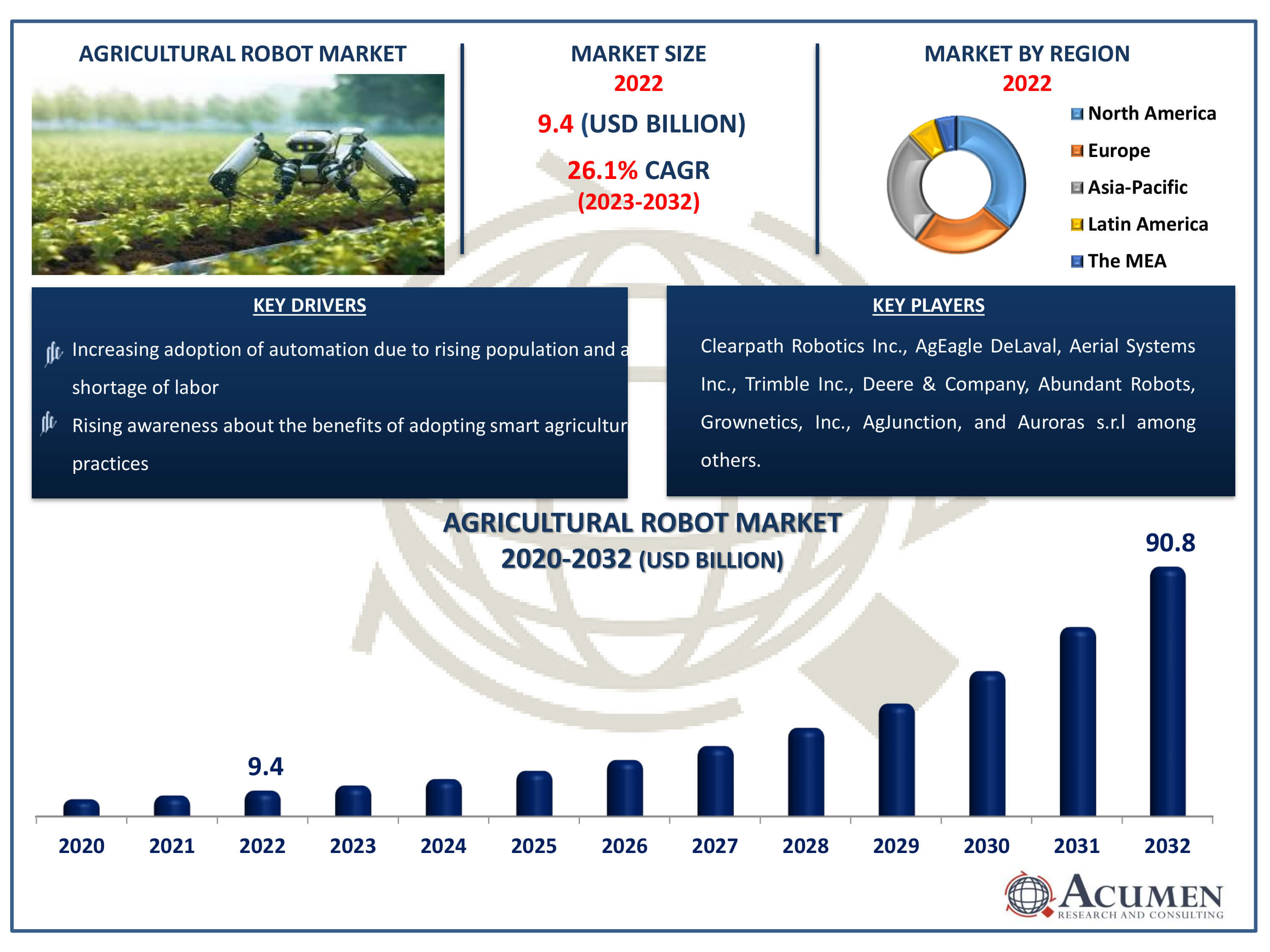
This strong growth reflects the industry's shift toward automation in response to several critical challenges — including rising labor costs, the demand for higher yields, sustainability goals, and the adoption of digital farming technologies.
Agricultural Robot Market Highlights
• Market Value (2022): USD 9.4 billion
• Forecast (2032): USD 90.8 billion
• CAGR (2023-2032): 26.1%
• Leading Region: North America
• Fastest Growing Region: Asia-Pacific
• Top Segments: Autonomous tractors and robotic harvesters
As agricultural operations become increasingly data-driven, the Agricultural Robot Market Share is expected to grow across both developed and emerging economies.
Key Drivers Fueling Agricultural Robot Market Growth
1. Global Labor Shortages in Agriculture
Agriculture is one of the world's most labor-intensive industries. However, the availability of agricultural labor is declining, particularly in advanced economies. This shortage, coupled with rising wages, has forced producers to look toward automation.
Robots that can perform repetitive, time-sensitive tasks such as planting, pruning, or picking are emerging as reliable substitutes for manual labor, ensuring operational continuity and cost efficiency.
2. Precision Agriculture and Smart Farming Adoption
Precision agriculture — the use of digital tools to optimize inputs and outputs — has gained significant traction worldwide. Agricultural robots are central to this practice, offering farmers real-time insights through imaging, sensors, and machine learning.
These tools help monitor soil conditions, manage irrigation, detect pests, and predict yields. As precision agriculture technologies expand, so does the demand for robotic systems capable of executing data-driven decisions autonomously.
3. Rising Demand for Food and Sustainability Pressures
The global population is expected to reach 9.7 billion by 2050, requiring a 70% increase in food production. Simultaneously, there's growing pressure to reduce the environmental footprint of farming.
Agricultural robots enable sustainable practices such as targeted spraying (reducing chemical use), precision irrigation (saving water), and optimized planting (improving soil health). These capabilities align closely with sustainability goals, driving further Agricultural Robot Market Growth.
4. Technological Advancements in Robotics and AI
The integration of AI, machine vision, and autonomous navigation has propelled the market to new heights. Modern agricultural robots can identify crop types, assess ripeness, and perform selective harvesting without human intervention.
Advancements in energy-efficient components, lightweight materials, and cloud connectivity are improving operational performance while reducing costs — making robots more accessible to mid-sized farms.
5. Government Support and Policy Initiatives
Governments worldwide are encouraging the adoption of agricultural robotics through grants, research incentives, and smart farming programs. For example:
• The U.S. Department of Agriculture (USDA) funds automation research under its "Farm of the Future" initiative.
• The European Union supports automation as part of the Common Agricultural Policy (CAP) and sustainability goals.
• Countries like Japan, China, and India are investing in smart agriculture programs that promote digital farming adoption.
These supportive frameworks are vital catalysts for the expanding Agricultural Robot Market Size.
Agricultural Robot Market Segmentation
The Agricultural Robot Market Report segments the industry by type, application, and region — reflecting its diversity and wide range of use cases.
By Type
• Autonomous Tractors and Field Robots - Perform planting, soil tillage, and hauling autonomously.
• Harvesting Robots - Designed for fruit, vegetable, and crop harvesting.
• Drones and UAVs - Used for aerial mapping, spraying, and monitoring.
• Weeding and Spraying Robots - Deliver targeted pesticide applications.
• Livestock Robots - Automate feeding, milking, and health tracking.
Among these, harvesting robots and autonomous tractors dominate market share due to their scalability and direct impact on yield optimization.
By Application
• Crop Production - Including planting, harvesting, spraying, and crop health monitoring.
• Livestock Farming - Focused on milking, feeding, and welfare management.
• Greenhouse and Nursery Automation - Supporting precision watering and plant management.
• Soil and Field Mapping - Monitoring soil health and topography for improved yields.
The crop production segment currently leads the market, though livestock automation is rapidly expanding with the introduction of AI-based animal health monitoring systems.
Agricultural Robot Market Regional Insights
North America: A Global Leader
North America holds the largest Agricultural Robot Market Share, with the United States leading in technology adoption. The region benefits from large-scale farms, strong research ecosystems, and significant venture capital investments in agritech startups.
Companies like John Deere, Blue River Technology, and Trimble have been at the forefront of deploying robotic solutions for precision spraying, autonomous driving, and intelligent harvesting.
Europe: Sustainable and Policy-Driven Growth
Europe's agricultural sector is rapidly integrating robotics as part of its transition toward climate-neutral farming. Government incentives under the European Green Deal and labor shortages in countries like France, Spain, and the Netherlands are propelling growth.
European manufacturers focus heavily on robotic weeders and greenhouse automation, aligning with the continent's sustainability and efficiency objectives.
Asia-Pacific: Fastest-Growing Market
The Asia-Pacific Agricultural Robot Market is expanding rapidly due to urbanization, mechanization, and food security concerns.
China and Japan are pioneers in integrating AI and robotics into small and mid-scale farming. India is also emerging as a high-growth market, with government-backed precision agriculture programs supporting startups in drone technology and automated machinery.
Latin America and Middle East & Africa: Emerging Frontiers
In Latin America, Brazil and Chile are adopting agricultural robots to modernize large-scale farms and reduce costs. Meanwhile, Middle Eastern nations such as Saudi Arabia and the UAE are investing in smart greenhouses and desert farming systems to enhance food independence.
Key Trends in the Agricultural Robot Market
1. Data-Driven Robotics
Robots are becoming smarter and more connected, integrating IoT devices, sensors, and cloud platforms to provide farmers with real-time analytics on soil, crop health, and weather conditions.
2. Swarm Robotics
Swarm robotics — using fleets of small, cooperative robots — is gaining traction for tasks such as planting and weeding, offering scalability for large farms.
3. Integration with Digital Platforms
Modern robots seamlessly connect with farm management systems for remote monitoring and automated decision-making.
4. Edge AI and Machine Learning
On-device processing allows agricultural robots to make instantaneous field decisions without depending on cloud connectivity, improving performance and reliability.
5. Electrification and Renewable Power
With sustainability goals intensifying, electric and solar-powered agricultural robots are replacing diesel-based systems, reducing emissions and operating costs.
Competitive Landscape
The Agricultural Robot Market Report highlights intense competition as established equipment manufacturers and tech startups race to commercialize new solutions.
Key Players:
• John Deere
• AGCO Corporation
• Kubota Corporation
• Trimble Inc.
• Naïo Technologies
• Harvest CROO Robotics
• Agrobot
• Blue River Technology
• Robotics Plus Ltd.
• Yanmar Holdings
These companies are focusing on expanding their product portfolios, R&D initiatives, and strategic partnerships to gain a competitive edge. Mergers, acquisitions, and pilot projects with agribusiness corporations are accelerating market penetration.
Benefits and Opportunities
1. Increased Productivity: Robots operate round-the-clock, boosting efficiency during peak seasons.
2. Reduced Input Waste: Targeted application of fertilizers and chemicals lowers costs and environmental impact.
3. Enhanced Crop Monitoring: AI-based systems detect disease, pest infestations, and stress early.
4. Improved Labor Conditions: Reduces manual workload and ensures safety in challenging environments.
5. Scalable for All Farm Sizes: From large commercial farms to smallholders, modular robotic systems can adapt to various scales of operation.
As the Agricultural Robot Market Growth continues, these benefits will encourage broader adoption, especially as technology becomes more affordable.
Challenges Ahead
Despite significant progress, several challenges remain:
• High Initial Costs: Upfront investment remains a barrier for smaller farms.
• Digital Literacy Gaps: Farmers require training to manage advanced robotic systems.
• Connectivity Issues: Limited internet infrastructure in rural areas restricts full-scale implementation.
• Interoperability: Integration across different platforms and devices remains a technical hurdle.
Addressing these challenges through better financing models, training programs, and open-data standards will be essential for sustainable market growth.
Future Outlook
The Agricultural Robot Market is poised for exponential growth through the next decade. By 2032, advancements in AI, 5G connectivity, and robotics will enable fully autonomous farming ecosystems — where drones, tractors, and sensors communicate seamlessly to execute every stage of cultivation with minimal human input.
The convergence of robotics with digital agriculture will also enable new business models, such as "farming-as-a-service," where technology providers deploy robots on-demand for specific farm operations.
As global food systems evolve toward sustainability and resilience, agricultural robotics will play an indispensable role in shaping the future of farming.
The Agricultural Robot Market is not just an evolution of farm machinery — it represents a revolution in how humanity grows food. Combining robotics, artificial intelligence, and automation, this market is driving agriculture into a new era of efficiency, sustainability, and precision.
As investments accelerate and technologies mature, farmers around the world will increasingly rely on intelligent machines to cultivate the crops that feed our planet. For detailed insights into segmentation, key players, and emerging trends, explore the comprehensive Sample Pages of Agricultural Robot Market Report by Acumen Research and Consulting.
Featured Product

The smartest dynamic LED grow light solution.
We set the standard in LED grow lights. No other grow light solution rivals Sollum's performance, thanks to innovation such as unmatched automatic dimming of light intensity and spectral in real time. Whether you grow specialty or mass market produce and all options in between, we have a cost-effective, environmentally friendly and fully supported LED grow light solution to fulfill your business needs.