
Synthetic Biology in Agriculture Market Trends 2024–2032: Driving the Next Green Revolution
The Synthetic Biology in Agriculture Market is projected to expand rapidly through 2032, with robust investment in biotechnology and advanced crop solutions improving food security and sustainable farming practices.
Synthetic Biology in Agriculture Market: Redefining Sustainable Farming and Food Security
Agriculture, the backbone of global food systems, is undergoing a transformation driven by biotechnology and genetic innovation. At the heart of this revolution lies synthetic biology in agriculture — an interdisciplinary field that combines biology, engineering, and computational science to design and construct new biological parts and systems.
As climate change, population growth, and resource scarcity challenge global food production, synthetic biology offers a path to achieve more with less — improving crop yield, resilience, and sustainability. According to the latest research by Acumen Research and Consulting, the Synthetic Biology in Agriculture Market is on a remarkable growth trajectory through 2032, supported by advances in genomics, government funding, and growing demand for bio-based agricultural inputs.
Understanding Synthetic Biology in Agriculture
Synthetic biology in agriculture applies engineering principles to biology, enabling the design and modification of genetic structures for targeted outcomes such as improved plant traits, biofertilizer development, pest resistance, and efficient nutrient utilization.
Unlike traditional genetic modification, synthetic biology uses advanced computational modeling and DNA synthesis tools to create customized biological systems. These innovations have applications ranging from creating drought-tolerant crops and nitrogen-fixing plants to developing eco-friendly pesticides and biofuels.
In short, synthetic biology transforms agriculture from a process of adaptation to one of intelligent design — creating resilient ecosystems aligned with environmental and economic goals.
Synthetic Biology in Agriculture Market Overview and Key Statistics
According to Acumen Research and Consulting's analysis, the global Synthetic Biology in Agriculture Market was valued at approximately USD 4.3 billion in 2023 and is projected to reach USD 71.9 billion by 2032, growing at a compound annual growth rate (CAGR) of 36.9% during the forecast period (2024-2032).
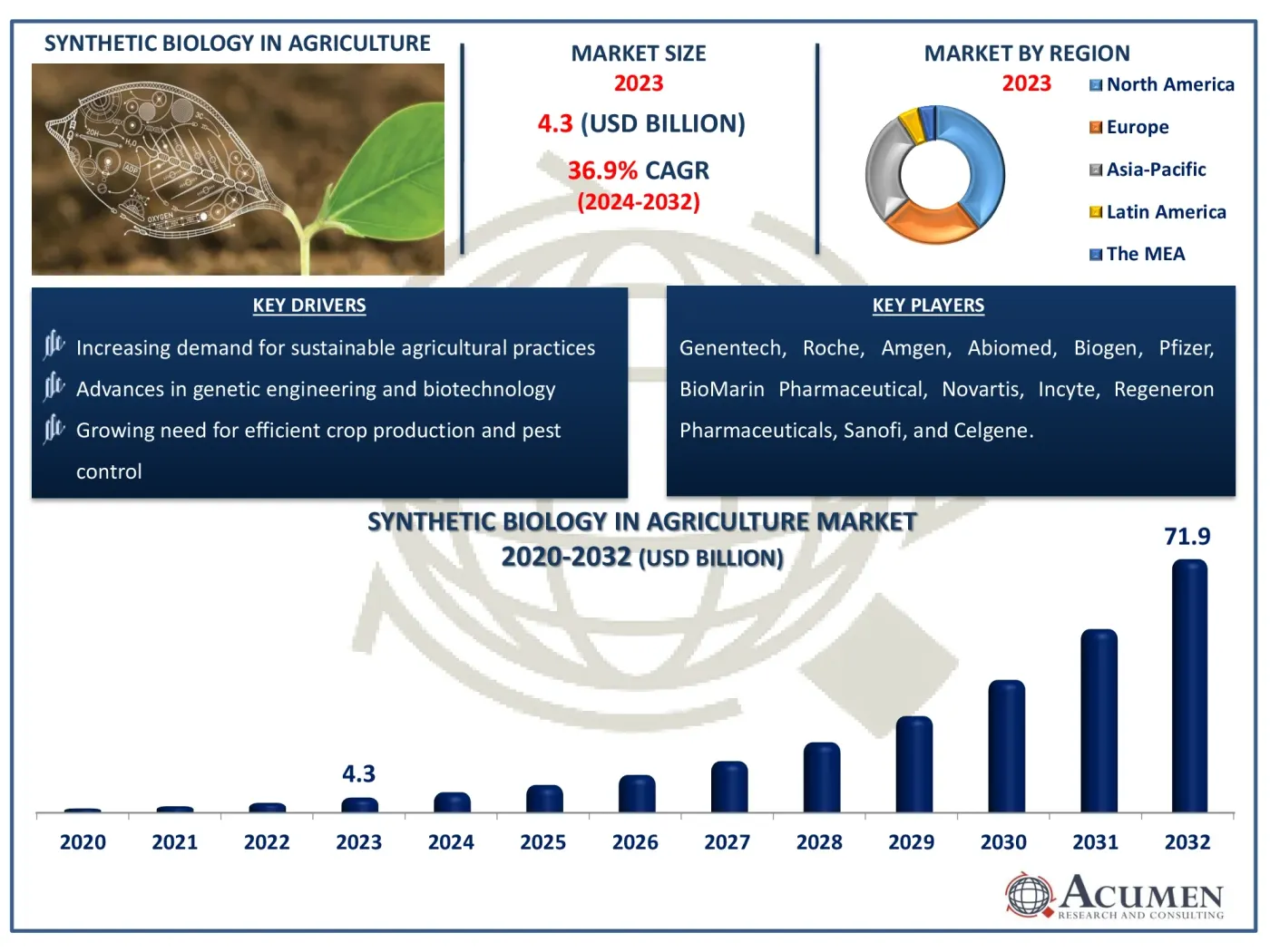
Synthetic Biology in Agriculture Market Highlights:
• 2023 Market Size: USD 4.3 Billion
• 2032 Forecast: USD 71.9 Billion
• CAGR (2024-2032): 36.9%
• Key Application Areas: Crop protection, crop yield improvement, food additives and ingredients, livestock improvement, and others
• Leading Region: North America
• Fastest Growing Region: Asia-Pacific
This rapid growth underscores the growing recognition of synthetic biology as a cornerstone for sustainable agriculture and bioeconomy development.
Key Drivers Fueling Synthetic Biology in Agriculture Market Growth
1. Rising Global Food Demand
With the global population expected to exceed 9.7 billion by 2050, food production must increase by nearly 70% to meet demand. Traditional agricultural practices face constraints due to water scarcity, soil degradation, and climate variability. Synthetic biology helps address these limitations by creating high-yield, resource-efficient crops capable of thriving under stress conditions.
For example, synthetic nitrogen fixation technologies allow non-leguminous plants to derive atmospheric nitrogen, reducing the need for chemical fertilizers — a major step toward eco-friendly farming.
2. Growing Focus on Sustainable and Climate-Resilient Agriculture
The Synthetic Biology in Agriculture Market benefits from rising awareness about climate-smart agriculture. Biologically engineered microbes and plants are being used to enhance carbon sequestration, reduce methane emissions, and improve soil health.
Companies are developing synthetic microbial consortia that promote root growth and resilience, enabling farmers to adapt to changing environmental conditions while maintaining productivity.
3. Technological Advancements in Gene Editing and DNA Synthesis
Breakthroughs in CRISPR-Cas9, gene drives, and automated DNA assembly have lowered costs and accelerated innovation. Scientists can now design plant genomes with high precision, improving drought resistance, disease tolerance, and nutrient uptake.
The availability of open-source genetic databases and bioinformatics platforms further enhances R&D efficiency across agricultural biotechnology firms.
4. Government Support and Investment in Biotechnology
Governments across North America, Europe, and Asia are investing in agricultural biotechnology to strengthen food security and reduce dependency on chemical inputs.
For instance:
• The U.S. Department of Agriculture (USDA) funds R&D programs in synthetic biology to promote sustainable crop systems.
• The European Commission's Horizon Europe initiative supports bioengineering research for food sustainability.
• In India, national policies encourage biotech startups to develop microbial fertilizers and engineered crops.
Such funding and policy frameworks significantly boost market penetration and commercialization prospects.
5. Demand for Bio-Based Fertilizers and Pest Management Solutions
Synthetic biology is driving the next generation of biofertilizers and biopesticides, which are environmentally safe and tailored for specific soil and crop needs. Engineered microbes can deliver nutrients precisely when and where plants need them, minimizing chemical runoff and enhancing productivity.
As consumers and regulators push for reduced pesticide usage, the market for synthetic biology-driven natural pest control solutions is set to expand rapidly.
Synthetic Biology in Agriculture Market Segmentation Insights
By Application
• Crop Engineering: Genetic enhancement for higher yield, pest resistance, and stress tolerance.
• Soil Microbiome Engineering: Tailoring microbial communities for improved soil fertility and health.
• Biofertilizers & Biopesticides: Development of environmentally safe agricultural inputs.
• Bioenergy & Biomaterials: Utilizing agricultural waste to create biofuels and sustainable materials.
By Technology
• Gene Editing
• Genome Sequencing
• Metabolic Engineering
• Synthetic Biology Platforms
• Other Technologies
The gene editing segment currently dominates the market due to increasing use in developing genetically enhanced crops and microbial strains for agriculture.
Synthetic Biology in Agriculture Market Regional Analysis
North America: Market Leader
North America holds the largest share of the Synthetic Biology in Agriculture Market, driven by advanced biotechnology infrastructure, strong R&D investments, and progressive regulatory policies.
The United States hosts numerous leading biotech firms and research institutions working on engineered crops, soil bacteria, and synthetic enzymes to enhance agricultural sustainability. Canada also contributes significantly, with government-backed initiatives supporting bio-based agricultural solutions.
Europe: Policy-Driven Expansion
Europe remains a key hub for sustainable agricultural innovation. Countries such as Germany, the Netherlands, and France are integrating synthetic biology into national bioeconomy strategies. The European Union's stringent environmental policies and focus on reducing chemical fertilizers are further accelerating adoption.
Asia-Pacific: Fastest-Growing Region
The Asia-Pacific market is experiencing rapid growth, fueled by expanding agricultural production and government incentives for biotechnology adoption.
China, India, and Japan are investing heavily in gene-editing research and biomanufacturing facilities. In India, synthetic biology startups are developing microbial fertilizers to improve soil health and crop resilience under climate stress.
Latin America & Middle East: Emerging Opportunities
Emerging economies in Brazil, Mexico, and the UAE are gradually adopting synthetic biology to enhance agricultural exports and reduce fertilizer imports. Pilot projects focusing on engineered crops and microbial bioinputs are gaining traction.
Leading Companies and Key Developments
The Synthetic Biology in Agriculture Market is moderately consolidated, with leading players investing in R&D collaborations, strategic partnerships, and product innovation.
Prominent Companies:
• Bayer AG
• Ginkgo Bioworks
• BASF SE
• Corteva Agriscience
• Amyris Inc.
• Zymergen Inc.
• Evogene Ltd.
• Pivot Bio
• Joyn Bio (Bayer + Ginkgo Bioworks JV)
• Pairwise Plants
Recent Developments:
• Pivot Bio launched microbial nitrogen fertilizers that reduce ammonia emissions and improve soil health.
• Ginkgo Bioworks and Bayer AG expanded their partnership to engineer microbes for crop protection.
• Evogene Ltd. introduced AI-driven computational biology tools for genome optimization.
• Corteva Agriscience is developing CRISPR-edited seeds designed for regional climate resilience.
These strategic initiatives underline how synthetic biology is transitioning from laboratory innovation to field-scale adoption.
Benefits and Opportunities
1. Enhanced Crop Yields
Engineered crops can deliver higher yields under drought, salinity, and temperature stress conditions — a critical advantage amid global climate change.
2. Reduced Chemical Inputs
Bio-based fertilizers and synthetic microbes decrease reliance on synthetic agrochemicals, mitigating pollution and reducing agricultural carbon footprints.
3. Precision Agriculture Integration
Synthetic biology complements precision agriculture by enabling genetic-level control over crop behavior, nutrient absorption, and pest response.
4. Sustainable Food Supply Chains
By enabling local production of bio-based inputs and improved crop efficiency, synthetic biology strengthens food security and reduces import dependencies.
Challenges to Synthetic Biology in Agriculture Market Growth
Despite promising potential, the Synthetic Biology in Agriculture Market faces several challenges:
• Regulatory Uncertainty: Many countries are still developing frameworks to classify and approve synthetic biology products.
• High R&D Costs: Advanced bioengineering research requires substantial investment in infrastructure and skilled talent.
• Ethical and Environmental Concerns: Public perception regarding gene editing and biosafety can slow adoption.
• Technology Access Gap: Developing nations may face challenges in accessing high-end genomic tools and expertise.
Addressing these challenges through harmonized regulations and global collaboration will be key to unlocking full market potential.
Government Initiatives Supporting Growth
• U.S. National Bioeconomy Blueprint: Promotes industrial-scale application of synthetic biology for agriculture and energy.
• EU Circular Bio-Based Europe Joint Undertaking (CBE JU): Funds agricultural biotech startups focused on soil health and biofertilizers.
• India's Biotechnology Industry Research Assistance Council (BIRAC): Supports local innovation in agricultural biosolutions.
• China's Five-Year Plan for Biotechnology: Prioritizes synthetic biology for sustainable food production and rural revitalization.
These initiatives demonstrate strong policy alignment with global sustainability goals and the UN's 2030 Agenda for Sustainable Development.
Future Outlook of Synthetic Biology in Agriculture Market
The future of the Synthetic Biology in Agriculture Market is intertwined with the evolution of sustainable food systems and climate-resilient farming.
By 2032, synthetic biology is expected to become a mainstream pillar of modern agriculture, driving advancements in:
• Self-fertilizing and pest-resistant crops
• Carbon-neutral farming practices
• Bio-based fertilizers and circular bioeconomies
• AI-assisted genome design and synthetic enzyme production
The convergence of AI, genomics, and sustainable farming technologies will redefine agriculture's role in global climate solutions.
The Synthetic Biology in Agriculture Market represents a transformative leap toward smarter, more sustainable food production. With its ability to engineer resilient crops, optimize soil health, and reduce environmental impact, synthetic biology is poised to become a cornerstone of the 21st-century agricultural revolution.
As governments, corporations, and research institutions collaborate to scale innovation, synthetic biology will not only reshape agriculture but also pave the way for a regenerative and sustainable global bioeconomy.
For deeper insights, detailed forecasts, and segmentation analysis, request comprehensive Sample Pages of Synthetic Biology in Agriculture Market Report from Acumen Research And Consulting now.
Featured Product

Advanced Mid-Power and High-Power LEDs for Horticulture Lighting
Cree LED's J Series® family offers a comprehensive portfolio of mid-power and high-power LEDs engineered specifically for horticulture lighting. The lineup includes high-efficacy 2835, 3030 and 5050 platforms designed to maximize photon output, energy efficiency, and long-term reliability in demanding grow environments. Photophyll™ Select options in the JB3030C and 2835 platforms deliver industry-leading efficiency with excellent sulfur resistance and footprint compatibility with 301B/H devices - making design-in seamless for horticulture luminaires. The 2835 N-Class color portfolio adds even greater flexibility with 15 high-efficacy spectral options that support precise spectrum tuning. For high-power applications, the JR5050C provides the industry's highest efficacy in its class and can reduce system costs by up to 40%. The JR5050B complements this with best-in-class efficacy in both 6V and 30V configurations. The J Series portfolio also features top-performing white LEDs. The JB3030C delivers up to 3.33 PPF/W (typical), while the JB2835B offers the highest efficacy available in a 2835 white platform. Together, these solutions give horticulture lighting manufacturers exceptional efficiency, broad spectral versatility and unmatched design flexibility.