GrowPods - Controlled Environment Farms From ACTX - May Have An Important Role In The Future Of Farming
-Controlled Environment Farms can improve access to affordable, high-quality and nutritious food -Leading researcher said vertical farming may take over approximately 50% of the leafy green markets in the U.S.
Advanced Container Technologies, Inc. (Ticker: ACTX), announced that GrowPods - its brand of innovative controlled environment farms - may play an important role in feeding the world, which is predicted to explode to almost 10 billion people in about one generation.
Wilbur-Ellis, a global leader in agriculture technology and products, said that Controlled Environment Agriculture will play an important role in future farming by improving access to affordable, high-quality, and nutritious produce. "Its potential to offer consumers and supply chain stakeholders resilient, sustainable, local produce is becoming increasingly valuable in the face of rising input costs and environmental variability."
What is Controlled Environment Agriculture (CEA)?
CEA includes indoor and vertical farming practices such as hydroponics, aeroponics, and aquaponics that create sustainable, optimized growing conditions while protecting crops from pests and diseases.
CEA encompasses a variety of systems that deliver tangible environmental and production benefits growers can realize quickly after adoption.
Foresight News reports this new breed of modern farming is looking to completely revolutionize the way in which we produce food, moving away from the soil and open spaces of the countryside and into the abandoned buildings and tight spaces of the city.
The Urgent Need for CEA
The United Nations reports that global population is expected to reach nearly 10 billion by 2050, which will require a 70% increase from current levels of global food production.
In this context, Controlled Environment Agriculture has emerged as a potential solution due to its ability to produce high yields in small spaces using little water and no soil.
For certain crops vertical farms can provide from 10 to 20 times the yield per acre compared to open-field crops, according to the US Department of Agriculture. Furthermore, in places such as deserts or high-population urban areas where traditional open-field farming is not practical, vertical farms can provide crop production year round, which multiplies the productivity of the farmed surface by a factor of between four and six, depending on the crop.
Furthermore, there are CO2 reduction benefits tied to the fact that with localized production there is no need for long distance transportation or certain kinds of farm machinery.
Another major advantage of vertical farming is the efficiency that can be gained from automation. Software, robotics and data science allows for unprecedented accuracy in controlling water use, temperature, lighting, and humidity.
The Future
Dr. Kai-Shu Ling, a research plant pathologist, said in an interview with the US Department of Agriculture that although vertical farming is an emerging technology it has huge potential for growth.
"I believe that it's possible that vertical farming can take over approximately 50% of leafy green markets in the U.S. and portions of small fruit and tomato markets in 10 years," he said.
GrowPods are designed and manufactured in America, and can be used by individuals and businesses looking to grow the finest quality hemp, vegetables, and leafy greens.
For information on GrowPods, call ACTX at: (951) 381-2555 or visit: www.AdvancedContainerTechnologies.com
Featured Product
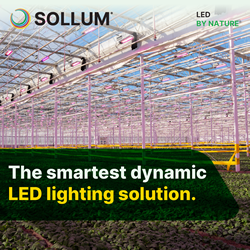
The smartest dynamic LED grow light solution.
We set the standard in LED grow lights. No other grow light solution rivals Sollum's performance, thanks to innovation such as unmatched automatic dimming of light intensity and spectral in real time. Whether you grow specialty or mass market produce and all options in between, we have a cost-effective, environmentally friendly and fully supported LED grow light solution to fulfill your business needs.