
Mr Nicholas Wright – The Role of Drones in Improving Agricultural Outcomes

Introduction

Unmanned aerial vehicles, commonly known as drones, operate without a human pilot aboard. Rather, they fly either autonomously, using onboard computers, or by a ground-based controller, via a system of communications between the two. Drone technology, and their use is rapidly increasing: unmanned vehicles are in use across a range of sectors, including defence, journalism and film photography, express shipping and delivery, thermal sensor drones for search and rescue operations, law enforcement and border control surveillance and weather forecasting.

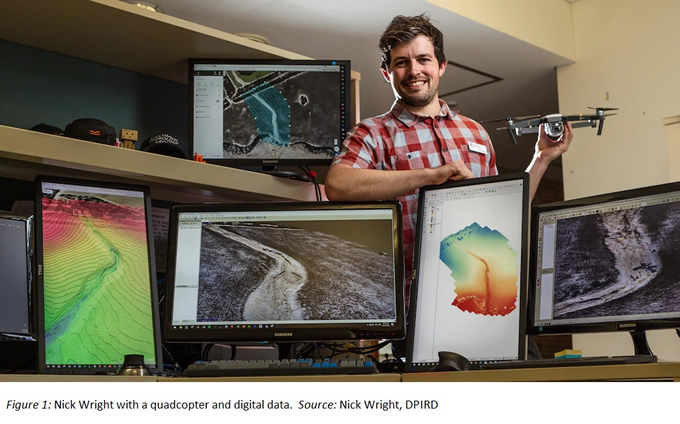
In agriculture and food production drones are becoming important tools for farmers, land managers and scientists to review and monitor the status of their crops and animals. The Western Australian Department of Primary Industries and Regional Development (DPIRD) is using drones across a range of applications to enhance its effectiveness in helping to manage land use.  FDI has taken the opportunity to interview Nick Wright, a DPIRD Research Officer, to discuss the use of drone technology in Australian agriculture.
Full Interview here:

Comments (0)

This post does not have any comments. Be the first to leave a comment below.


Post A Comment

You must be logged in before you can post a comment. Login now.

Featured Product

Advanced Mid-Power and High-Power LEDs for Horticulture Lighting

Advanced Mid-Power and High-Power LEDs for Horticulture Lighting

Cree LED's J Series® family offers a comprehensive portfolio of mid-power and high-power LEDs engineered specifically for horticulture lighting. The lineup includes high-efficacy 2835, 3030 and 5050 platforms designed to maximize photon output, energy efficiency, and long-term reliability in demanding grow environments. Photophyllâ„¢ Select options in the JB3030C and 2835 platforms deliver industry-leading efficiency with excellent sulfur resistance and footprint compatibility with 301B/H devices - making design-in seamless for horticulture luminaires. The 2835 N-Class color portfolio adds even greater flexibility with 15 high-efficacy spectral options that support precise spectrum tuning. For high-power applications, the JR5050C provides the industry's highest efficacy in its class and can reduce system costs by up to 40%. The JR5050B complements this with best-in-class efficacy in both 6V and 30V configurations. The J Series portfolio also features top-performing white LEDs. The JB3030C delivers up to 3.33 PPF/W (typical), while the JB2835B offers the highest efficacy available in a 2835 white platform. Together, these solutions give horticulture lighting manufacturers exceptional efficiency, broad spectral versatility and unmatched design flexibility.